What the IRS Asks For in a Cannabis §280E Exam
A §280E exam is not a normal IRS audit. The examiner already knows your deductions are limited — the entire exam is built around proving what you put into cost of goods sold and whether your cost allocation holds up. Here is what they will actually ask for, and where boutique cultivators usually get caught.

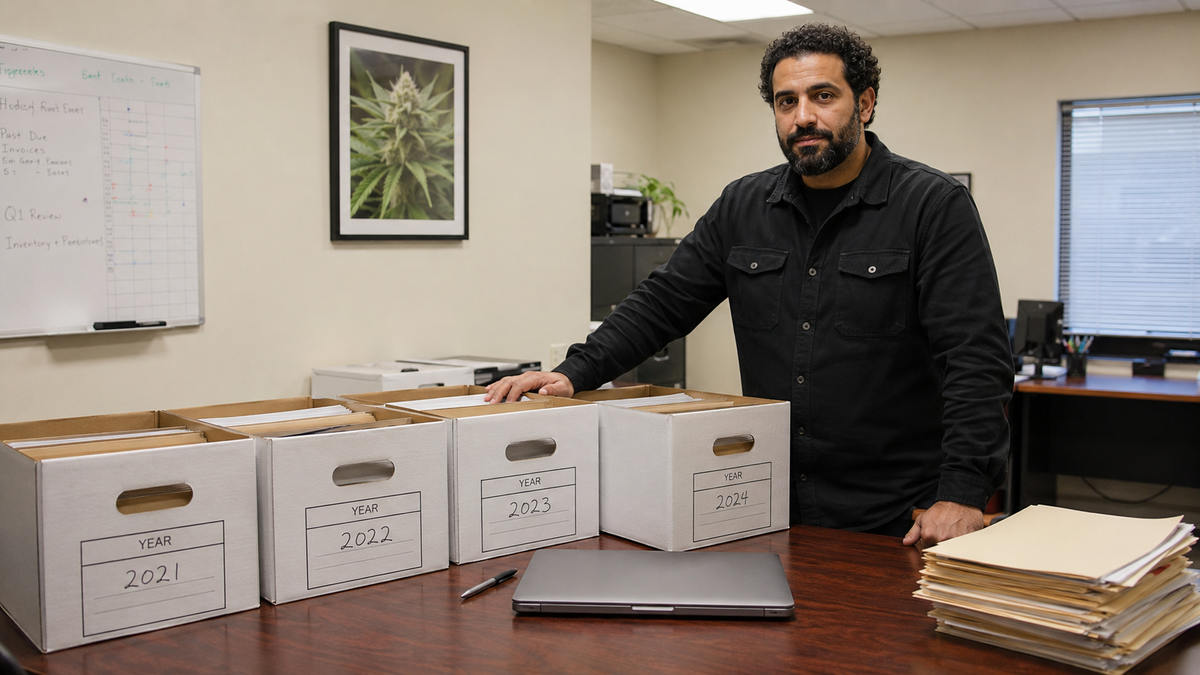
This is for the boutique cultivator who has never been examined and whose COGS workpapers — if they exist at all — are thin. Maybe a notice just arrived. Maybe one hasn't, and you want to know how exposed you would be if it did. Either way, the first thing to understand is that a §280E exam is not a fishing expedition into your whole return. The examiner walks in already knowing the answer to the biggest question — your ordinary business deductions are disallowed — and spends the entire exam on the one number that still moves your tax: cost of goods sold.
Why a §280E exam is different
§280E disallows deductions and credits for a business trafficking in a Schedule I or II controlled substance. For a cannabis operator, that has always meant one lane to reduce taxable income: COGS. So the examiner is not testing whether you can deduct rent, payroll, or marketing — on the adult-use side, they already know you cannot. They are testing what you moved into COGS, whether you were entitled to move it there, and whether the number is supported. The authority to demand your books and records for that purpose comes from §7602, which gives the IRS the power to examine any books, papers, records, or other data relevant to a return and to take testimony. That statute is the engine behind every document request you will receive.
Post-rescheduling there is a second front. Under current law, qualifying state-licensed medical activity now sits outside §280E, while adult-use remains Schedule I and fully inside it — so a dual-license grow has to allocate its costs between a §280E-exempt medical side and a §280E-bound adult-use side. That treatment is in effect but under legal challenge, and the transition-year timing should be verified against current IRS guidance before you file. Expect an examiner to test that split hard: every dollar pushed onto the deductible medical side is a dollar they will want to see justified.
What the IRS will actually ask for
The requests arrive as Information Document Requests — IDRs. In a §280E exam they cluster into predictable categories:
- The §280E / COGS computation and its workpapers — the schedule showing how you built cost of goods sold, and the support behind it.
- Inventory schedules reconciled to Metrc and your POS — the examiner ties your reported inventory and production to the state seed-to-sale system and your point-of-sale data.
- The medical-vs-adult-use allocation method and its basis — for dual-license operators, how you split costs and why that basis is reasonable.
- Bank statements and cash-handling records — cash-intensive businesses draw extra scrutiny, and the bank record is where reconstruction starts.
- Payroll records and the treatment of labor in COGS — which wages you capitalized into production and which you did not.
- Purchase records, vendor invoices, and cultivation input costs — the raw-material and direct-cost trail.
- State license and designation records — to confirm which activity is medical and which is adult-use.
None of that is exotic. It is the ordinary evidence of how a grow spends money and turns it into product — which is exactly why the operators who cannot produce it are the ones who get hurt.
Where boutique cultivators get caught
Four failure patterns come up again and again.
No workpapers. If your COGS number has no schedule behind it, the examiner will reconstruct one — and a reconstructed COGS almost always comes in lower than the number you reported, because the examiner will not capitalize the indirect production costs you never documented.
Indirect production costs expensed as SG&A. Rent for the grow, the power running your lights, cultivation supervision — booked to operating expense instead of capitalized into inventory. On the adult-use side, §280E disallows them there, and they are lost entirely.
An allocation that does not tie to anything. A medical/adult-use split — or a production-vs-SG&A split — that is not grounded in something verifiable like licensed canopy square footage is the first thing an examiner pulls apart.
Cash and payroll irregularities. These do not just cost you inside the §280E exam; they open new fronts. Unreported large cash receipts pull in §6050I and Form 8300; under-deposited payroll taxes pull in §6672 and personal liability. A focused exam becomes an expanded one.
What reconstruction actually does to you
When your COGS is unsupported, the examiner does not give up — they rebuild it from the records you do have: bank deposits, Metrc production data, vendor invoices, POS reports. That rebuilt number is constructed to the examiner's advantage. It typically strips out the indirect production costs you failed to capitalize, and it can revalue inventory — testing whether you carried it at full-absorption cost or understated it. The lesson is not that reconstruction is unfair; it is that whoever brings the documentation controls the number. If that is the examiner, you lose the benefit of every cost you cannot prove.
There is a related trap worth naming: refund claims. The IRS is actively contesting cannabis refund claims right now, and a refund claim can itself invite an exam. If you are weighing an amended return to recover prior-year tax, understand that you may be inviting the examiner in — so go in with the workpapers already built, not after the notice lands.
What to have ready — before the exam, or to prepare one
Whether you are under exam or getting ahead of one, the readiness checklist is the same:
- Assemble the full-absorption workpapers — the schedule that shows every direct and indirect production cost flowing into COGS.
- Reconcile COGS to Metrc, your POS, and the trial balance, so the three tie.
- Document the medical/adult-use allocation method and the basis behind it.
- Organize bank, payroll, and vendor records by year, so any IDR can be answered cleanly.
- Have your EA review the position before you respond to anything the IRS sends.
The first response shapes the whole exam
Here is the risk in one line: responding to an IDR without organized, defensible records is how a narrow exam becomes a wide one. The records you produce — or fail to produce — in that first response set the examiner's read on the entire return. Produce a clean, reconciled COGS package and the exam tends to stay on COGS. Produce a shoebox and you invite reconstruction, an inventory challenge, and a look at your cash and payroll. Never give an unprepared response, and never give one without representation. Under §7602 the examiner is entitled to ask; you are entitled to answer deliberately, in writing, with your EA.
Start with the $375 allocation audit and a ten-minute fit call. Even if no notice has arrived, the audit is the prep work — I'll tell you where your records would fail an examiner and what to fix now, while you still have time to fix it. And if a notice has already landed, we move straight to representation and answer the IRS from a prepared position, not a defensive one.
Book the $375 audit→
Don't miss the next issue
Don't miss our next ripe issue, dropping — a fresh harvest of legal and operational insight to keep you green and growing. Subscribe below.
Subscriptions open soon.
This article is educational and does not constitute tax or legal advice. No client relationship is created by reading it. Federal cannabis scheduling and IRS guidance are changing rapidly in 2026; verify the current status before acting. For positions specific to your operation, engage under a signed representation agreement (Form 2848).